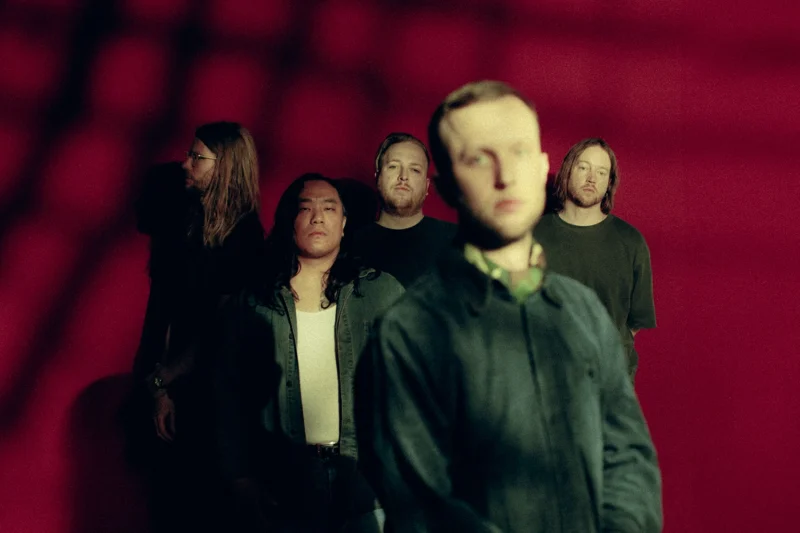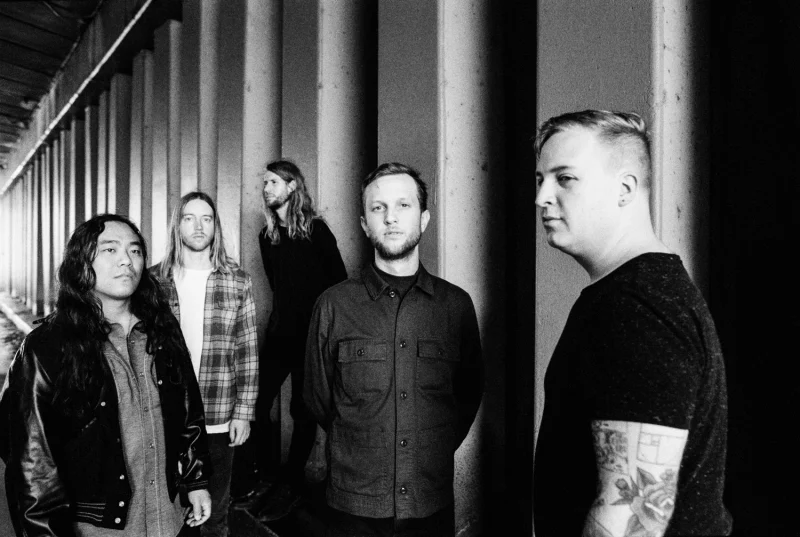
La Dispute are not ones to shy away from the concept album format. Throughout their career, they’ve become specialist in creating complex narratives. Whether that’s on the introspective storytelling of 2011’s ‘Wildlife’ or the deeply demanding ‘Panorama’ six years ago. Now the Grand Rapids, Michigan band, have returned with ‘No One Was Driving The Car’ It’s a record that is considerably their most conceptually ambitious. Framed as a five-act film, vocalist Jordan Dreyer used the 2017 American psychological thriller, ‘First Reformed’, as inspiration, along with a 2021 story of a fatal crash involving a self-driving Tesla car. It results in an engulfing, cinematic record that peels itself with each listen.
The opening of Act I, ‘I Shaved My Head’, sees an anguished Dreyer build the intensity alongside Adam Vass’ fuzzy bass. As the rest of the band, guitarists Chad Morgan-Sterenberg and Corey Stroffolin and drummer Brad Vander Lugt, join them, the band’s assured, emotive post-hardcore is in full flow. Conceptually, it introduces us to our central character, a desperate individual who wants to be unrecognisable. ‘Man with Hands and Ankles Bound’ rushes thanks to Morgan-Sterenberg and Stroffolin’s sharp exchanges. Lyrically, Dreyer’s words are voyeuristic yet are juxtaposed by societal judgement and vulnerability. Our character’s dissent continues on ‘Autofiction Detail’ as wiry guitars lend themselves to the despair that is unfolding. Dreyer abandons the spoken-sung style here in favour of refined singing.
Act II revolves around a standalone track – ‘Environmental Catastrophe Film’. The eight-minute number evolves from brushed-stroke drums and twinkling guitars to dense angst with Dreyer’s hook of “it only goes forward / forward / forward,” before settling into delicate acoustics. Capturing local environmental and industrial decay, it exemplifies La Dispute‘s captive storytelling and musical finesse perfectly.
The third act is painted as five vignettes of events that have shaped the album’s character. ‘Self-Portrait Backwards’ allows Dreyer to ruminate on domestic mundaneness, including binge-watching the same TV show over and over again. ‘The Field’ pulsates with intensity, complementing the panic-stricken words of the character’s younger self, discovering deer carcasses in a militia compound. ‘Sibling Fistfight at Mom’s Fiftieth / The Un-sound’ addresses generational conflict and family restlessness. Underpinned by a familiar intensity, it’s another example of La Dispute‘s musical sharpness. Multilevel marketing, religious exploitation, and predatory capitalism are the aims of ‘Landlord Calls the Sheriff In’. Finally, ‘Steve’ recollects a lost friend to suicide. He remembers skidding in circles across icy church carparks. After growing apart, ‘Steve’ reappears as someone who appeared to have their life sorted, but didn’t.
‘Top-Sellers Banquet’ kicks starts Act IV with a critique of wealth, religious rapture, and consumption. Split into two parts, the first is rigid in execution, setting up a scene of lavishness before a power cut smashes into its pensive second part. Creating an apocalyptic scene, the banquet guests are in a panic as the director pulls the camera skywards. Musically, the band take a delicate and patient approach. The sense of separation is amplified on ‘Saturation Diver’. With the imagery of a diver trapped underwater, our character reflects on their failures, loss, and inevitability. Its tender acoustics segue into the daydream of ‘I Dreamt of a Room with All My Friends I Could Not Get In’. The dissociation and desperation of the central character are captured in a hazy dream. It’s a late album highlight that amplifies emotive execution.
The final act begins with the album’s title track. Dreyer’s yells penetrate above twinkling acoustics and distant keys. Lyrically, it captures existential fear of an unknown future, blending it with the repeated use of cameras. ‘End Times Sermon’ ends the record on a raw note of reflection. Contemplating humanity’s future, it’s a bleak, almost ominous, conclusion.
‘No One Was Driving The Car’ is incredibly demanding and complex. Stylistically, La Dispute‘s ponderous post-hardcore/emo sound rarely tests itself; it positions itself secondary to Dreyer’s often polarising spoken-sung narrative. At times, it can be tedious, yet its dense storytelling is certainly admirable. Pouring over Dreyer’s words reveals a layered story that reflects on identity, family, disassociation, capitalism, exploitation, fragile hope, and environmental collapse. Furthermore, the camera motif that is threaded throughout not only adds to its cinematic tone but also remarks on how we live in a world of constant technological observation.
The sheer weight of the record means it’s not the ideal album to be introduced to La Dispute to. However, it’s an accurate account of their finely detailed storytelling, pairing it with a reliable post-hardcore sound.
‘No One Was Driving The Car’ by La Dispute is available now on Epitaph Records.
Find La Dispute on Facebook | X (Formerly Twitter) | Instagram | Spotify | Apple Music | Linktr.ee